Friday, April 26, 2019

Middle School Science- Focus on Echo Hill Outdoor School 2019

The annual HCA overnight field trip wasn't always in the curriculum. In fact, the seventh grade didn't have an overnight trip until 2005 when I took our first group to Project Oceanology at The University of Connecticut's satellite research campus in Groton, CT. It was a fine program on Long Island Sound but the distance and logistics of getting there and back became problematic and too expensive to continue. The overnight aspect was appealing to the 7th grade because 5th and 6th went to College Settlement and the 8th grade went to Washington, D.C. on overnight adventures - and now the 7th grade did, too.   

Holy Child seventh graders have been travelling to Echo Hill Outdoor School (EHOS) on the upper Chesapeake Bay for several years. It is an highly anticipated three-day, two-night trip about 90 minutes from HCA. This year, 13 Seventh Grade intrepid students and two teachers made the trip from Monday, April 15th to Wednesday, April 17th.


The Chesapeake from The Bluff at EHOS


The weather was dry but VERY windy on Monday, but that didn't stop the superb staff at EHOS from taking us on our first adventure: a trip on the research vessel Twilight. Even though we didn't venture out into the larger bay, the certified USCG captain, Captain Ian, took our "crew" into sheltered inlets and creeks of the bay where we explored the local estuaries.


On the Twilight, our students gained hands-on experience about the importance of estuaries, watersheds, phytoplankton, and zooplankton. They caught and handled American eels, perch. and catfish in pre-set traps. They measured water turbidity with a Secchi Disk, saw numerous bald eagles, and learned about ospreys and their important role in the Chesapeake's food web.


That first evening was too chilly and windy for us to sleep in the platform tents so the staff put us into the dorms (boys and girls separate, of course). We were occupied with different activities before heading to The Whip (an old carnival ride structure re-purposed as a dining hall).


We learned about S.L.O.P. (ask a 7th grader!) and had fun doing so after enjoying the great food served family style. That evening, we went on a guided night hike to experience the quiet of the Bay and surrounding forest as sunset descended upon us.

On Tuesday, we went on our next adventure, the Giant Swing! Each student was encouraged to trust themselves, their equipment, and their teammates to go as high as they were comfortable on the 40-foot swing in the Adventure Camp. All students attempted the swing and many went all the way to the top!


After we congratulated each other on that mettle-testing adventure, where we were all successful in our own way, we grabbed lunch and headed on our next adventure to The Swamp and Scanoeing!


The boardwalk in the swamp.


Boarding the Scanoe!


Investigating methane-producing microbes!

Our investigation taught us, among other things, about the importance of swamps and marshes in the ecosystem, how organisms can adapt to environments without oxygen, and that mistletoe is actually a parasite growing in the swamp!

That evening, the staff provided us with a cookut in the woods where we enjoyed burgers cooked over a campfire (they even had vegetarian options available here, too). Following a hayride in the EHOS tractor, ably driven by James, we were able to spend Tuesday night in the bunks in our tents, girls in Near Side camp and the boys at Far Side camp. Conditions were rustic and somewhat primitive but everyone seemed to get a good night's sleep!


A typical EHOS tent


Sunset from The Bluff

On our final morning at EHOS, we ate in The Whip, packed for the trip home, and then headed
to the woods for a lesson in survival in the wilderness. We learned the fundamentals for constructing shelters out of materials at hand on the beach.


After that time on the shores of the Chesapeake, we headed to the woods to learn how to make a fire from materials found nearby...and how to extinguish it safely!


When we finished, it was time for a final lunch at the WHIP and then to board the bus home. We were all tired and maybe a little dirty, but full of memories from new and different experiences that will be with us forever!

Finally, many thanks to Dr. Kellich for leaving her children and joining us on our (non-glamping) adventure as the chaperone for the girls!


HCA's 7th Grade Class gathers with one of our instructors, Sauhil.


Friday, March 15, 2019

Middle School Science - March 2019

    The biggest science event of the year has come and gone! Students have received their assessments and the verdict is in: they did a fantastic job (for the most part)! Two eighth grade students, Marin and Victoria, elected to enter their outstanding experiments into the Delaware County Science Fair this year. (Entering the Delco Fair became self-selective last year since projects are no longer judged at HCA.)

     Marin entered her project, "Basketball Energy," and Victoria submitted hers, titled "How Do You Perceive Time?" Not surprisingly, both Victoria and Marin were selected to be interviewed by judges from academia and industry at the DCIU on Monday, March 11th. When students are called for an interview in middle school, it means they won an award!

     Victoria also won an award last year and built upon that success to win Honorable Mention in the category of Human Behavior this year. Marin entered her first Delco Fair this year as an eighth-grader (how about that for motivation!) and was rewarded with Third Place in the Physics category. Congratulations to Marin and Victoria on their hard work, motivation, and awards!


     Eighth grade students have been learning about the MINOH rule for conserving mass...in other words, learning how to balance chemical equations. They must demonstrate 90% proficiency in order to pass (or retake the test until they do so) since this is a skill they will definitely need to master in high school chemistry. I am thrilled to say that each and every student in the class achieved above 90% on their test on the first try! Way to go!


These are some of the balancing equation problems the 8th grade had to master!


     Grade 5 completed their study of populations and ecosystems with an in-depth study of our planet's six major terrestrial biomes. They collaborated in groups to research the climate and particular features of their assigned biomes and then used that information to build models of each in a realistic way. Their research was excellent and is displayed from the ceiling above each biome in the elevator hallway on the Middle School floor. Stop by and take a look the next time you're in the building!


     The 5th grade also started a new unit on energy and got off to a fun start by evaluating and verbalizing different ways energy from rubber bands can affect balloons. More fun while learning to come!


The Sixth and Seventh grade students hosted their parents after the ScienceEXPO and participated in some fun science activities. Seventh graders and their parents extracted DNA from strawberries while the Sixth graders investigated geode formation and broke open some Moroccan geodes with their visitors.


     Finally, Mr. Zwilling presented the wonders of liquid nitrogen to the entire school. He dazzled us and informed us in an entertaining way how LIN can be used in a number of different ways to improve our quality of life!


Thursday, February 14, 2019

Middle School Science- ScienceEXPO 2019

CONGRATULATIONS to everyone for a job well done at ScienceEXPO 2019!


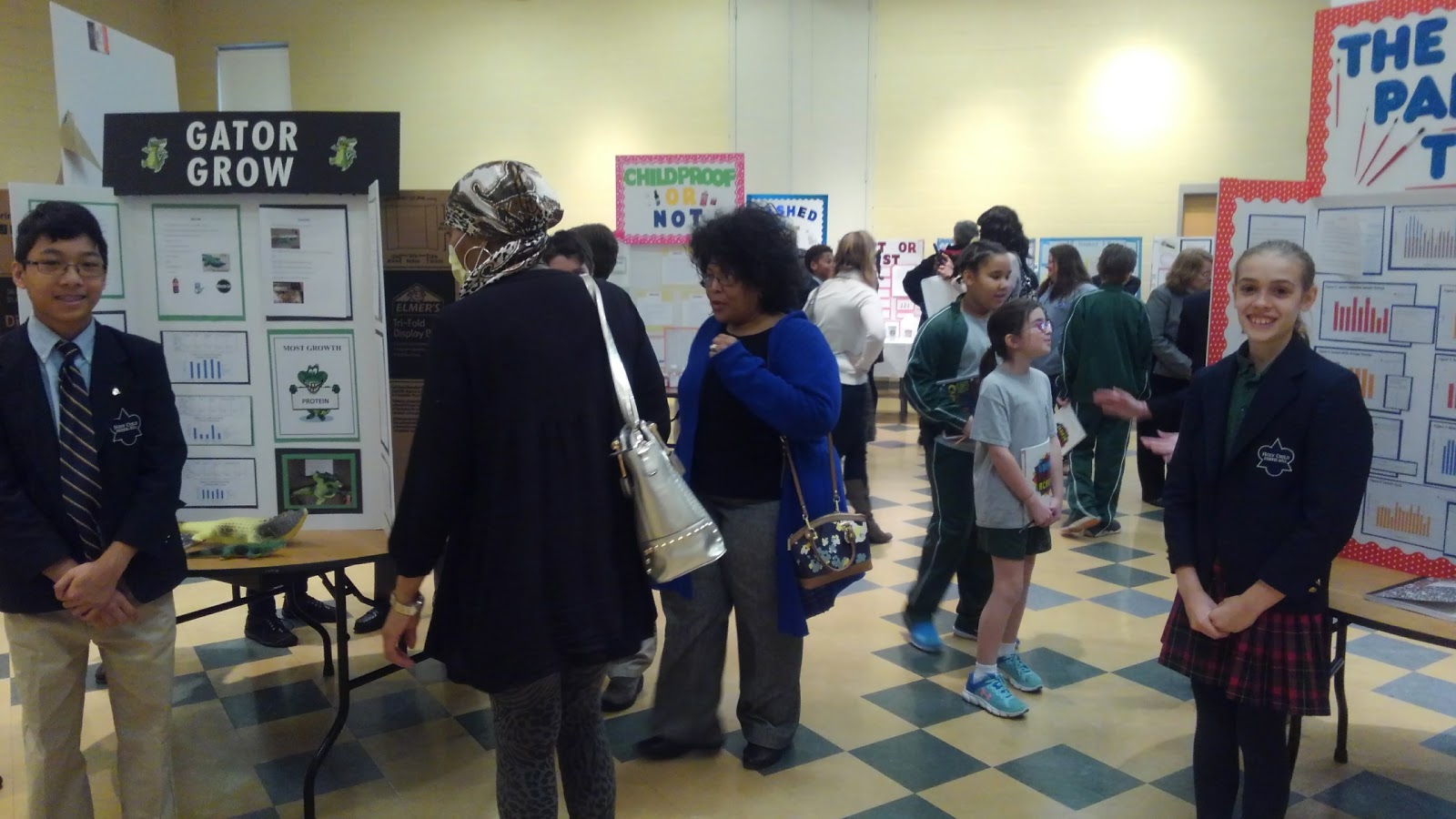
     Students in grades 6, 7, and 8, presented their finished ScienceEXPO experiments on Parent Visitation day last week! These projects began last October with ideas of problems to be explored and hypotheses to be formulated. For the 8th grade students, this was their third ScienceEXPO and most were very knowledgeable of the processes and procedures that allowed them to arrive in February with a well-executed project. Like the students in grades 6 and 7, the 8th graders submitted specific sections of their projects in small increments for review and revision. They followed the HCA ScienceEXPO website guidelines and turned their assigned sections in via Google Classroom for review. Examples of previous boards were presented and reviewed for strengths and weaknesses.


     After much work reviewing existing literature on their subject, outlining needed experimental materials (all in metric), and streamlining their procedures, they identified their variables and began their experimentation. All students ran multiple trials and collected data which were analyzed and put into Google Sheets to make tables and graphs. Then came time to make their presentation boards for display at school, culminating on Parent Visitation day. One constant they were provided with for making their board was, "How do you want to feel when you are in front of your board that day?"


I think they felt FANTASTIC!

Friday, January 25, 2019

Middle School Science- January 2019

     The new year began the same way the old year ended - BUSY!

      Grades 6, 7, and 8 are deep into their ScienceEXPO projects and have been busy testing hypotheses to gather data at school, at home, and in the field. ScienceEXPO 2019 begins at HCA on Wednesday, February 6th and concludes on Parent Visitation Day on Friday, February 8th. Students will be in front of their posters and ready to discuss their projects with visitors from 8:15 to 8:55 AM on the 8th so please come and support our student scientists!


     The 8th grade is studying the Periodic Table of Elements and learning how to use it as a tool. Instead of memorizing the first 20 or so elements, they can, for instance, use the family name and period to determine an element's relative atomic size or how many valence electrons an element will have. They conducted a lab to see how different compounds with elements of the same family behave similarly and, conversely, how they contrast in precipitate formation with elements of different families.


     Grade 7 is investigating chromosomal structure, genes, and DNA as a build-up to their study of cell division. They will use this to better understand mitosis and meiosis. Part of the DNA study included building a simple model of DNA nucleotides, matching adenine with thymine and cytosine with guanine along a sugar-phosphate backbone. It is proudly displayed in the Science hallway! Next up will be the isolation and extraction of DNA from strawberries in the lab.


     Grade 6 has been continuing their work on the four Earth systems and have been reinforcing their knowledge of maps, latitude, and longitude. I think its a pretty good bet that any 6th grader doesn't need GPS to find their location anywhere on a map since they know how to plot the coordinates of their location! They also investigated Buckminster Fuller's unusual Dymaxion maps. They built replicas and pieced the round Earth onto a flat plane, helping them better understand why it is difficult to map our sphere as a flat map.


     Grade 6 also did a wonderful job performing their One Act play about the Lost Boys first encounter with Wendy in Peter Pan. Their next performance will be on Friday, February 8, 2019 during Parent Visitation Day!


     Grade 5 studied watersheds and their importance locally, nationally, and globally. They modelled watersheds and demonstrated how water moves between ridges into localized areas. They also modelled how smaller watersheds combine to form larger and larger watersheds.


Grade 5 has recently started their research project on the six major terrestrial biomes of the Earth. They will use their research to make infographics about the characteristics of each then build a representative model of their biomes that will be on display near the elevator on the Middle School floor through Parent Visitation day. Be sure to check out their collaborative and creative efforts!


Friday, December 14, 2018


SEASON'S GREETINGS!
Image result for holly and wreath

     This eclectic edition of my blog will contain images from our busy weeks between Thanksgiving and the Christmas break. Sixth, seventh, and eighth graders are busy readying the final steps for their ScienceEXPO experiments. Our fifth grade students are almost finished with their ecosystem projects and will soon begin constructing their biome models on the Middle School floor near the elevator.

Enjoy the pictures of our very active students and I wish you all the very best this holiday season...Merry Christmas!

The 5th Grade collaboratively researched organisms to make an accurate and intricate food web that included producers, 1st order, 2nd order and 3rd order consumers, including some apex predators, as well as decomposers. It was very well done!


On Pajama Day, which raised funds for CHOP, the 5th Grade measured how energy is passed along from producers to 3rd order consumers in a pond ecosystem. Obviously, they were very chill that day!


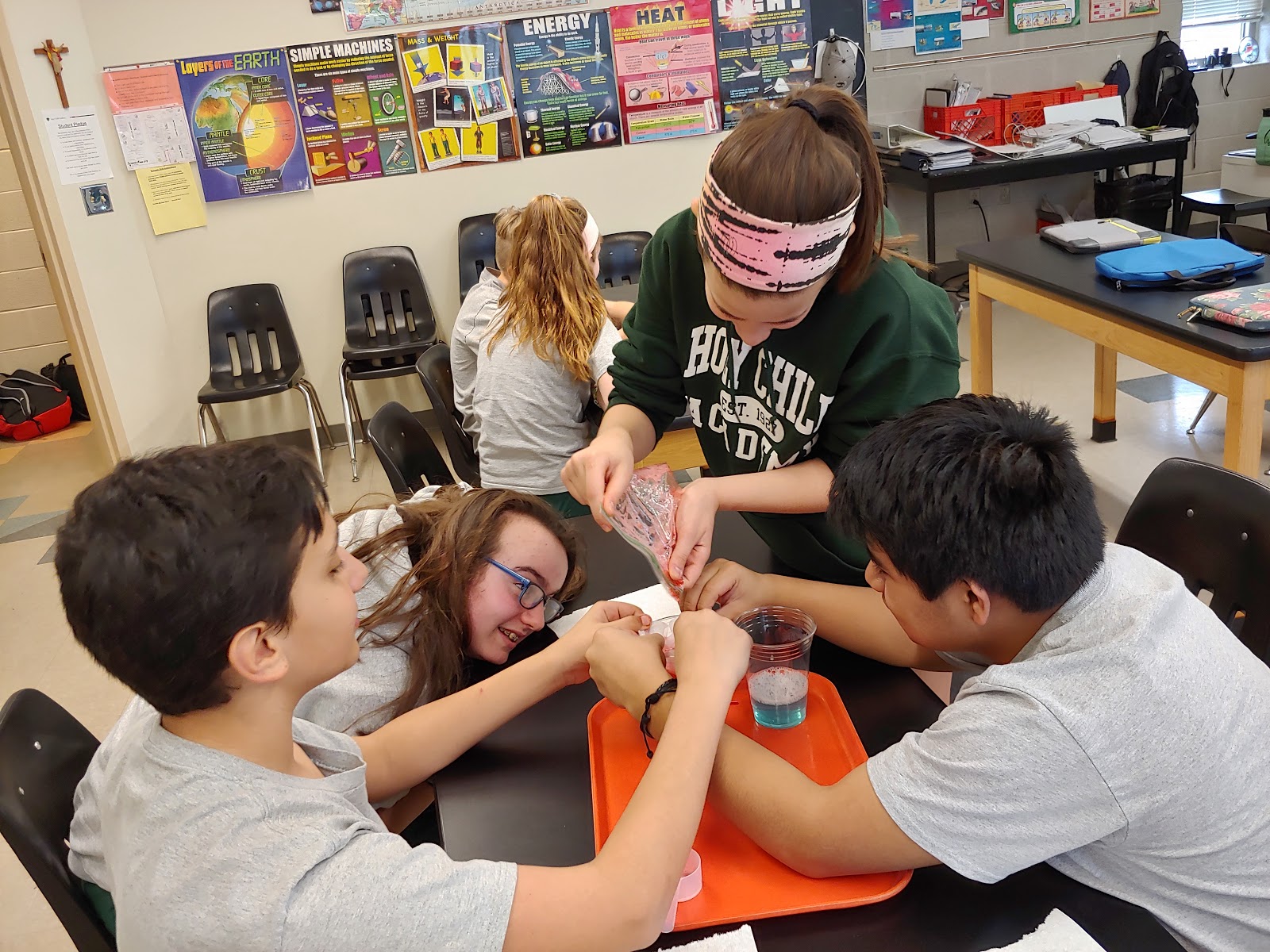
The 7th Grade investigated the difference between osmosis and diffusion across a selectively permeable membrane in the lab as they continued their study of how cells work.


The 8th Grade used their "Smarties" to practice electron orbital loading as they worked on atomic structure and why elements are located on the Periodic Table where they are.


Grade 6 researched the Earth's Major Systems and worked collaboratively to create infographic posters on the interactions between the atmosphere, biosphere, geosphere, and hydrosphere.


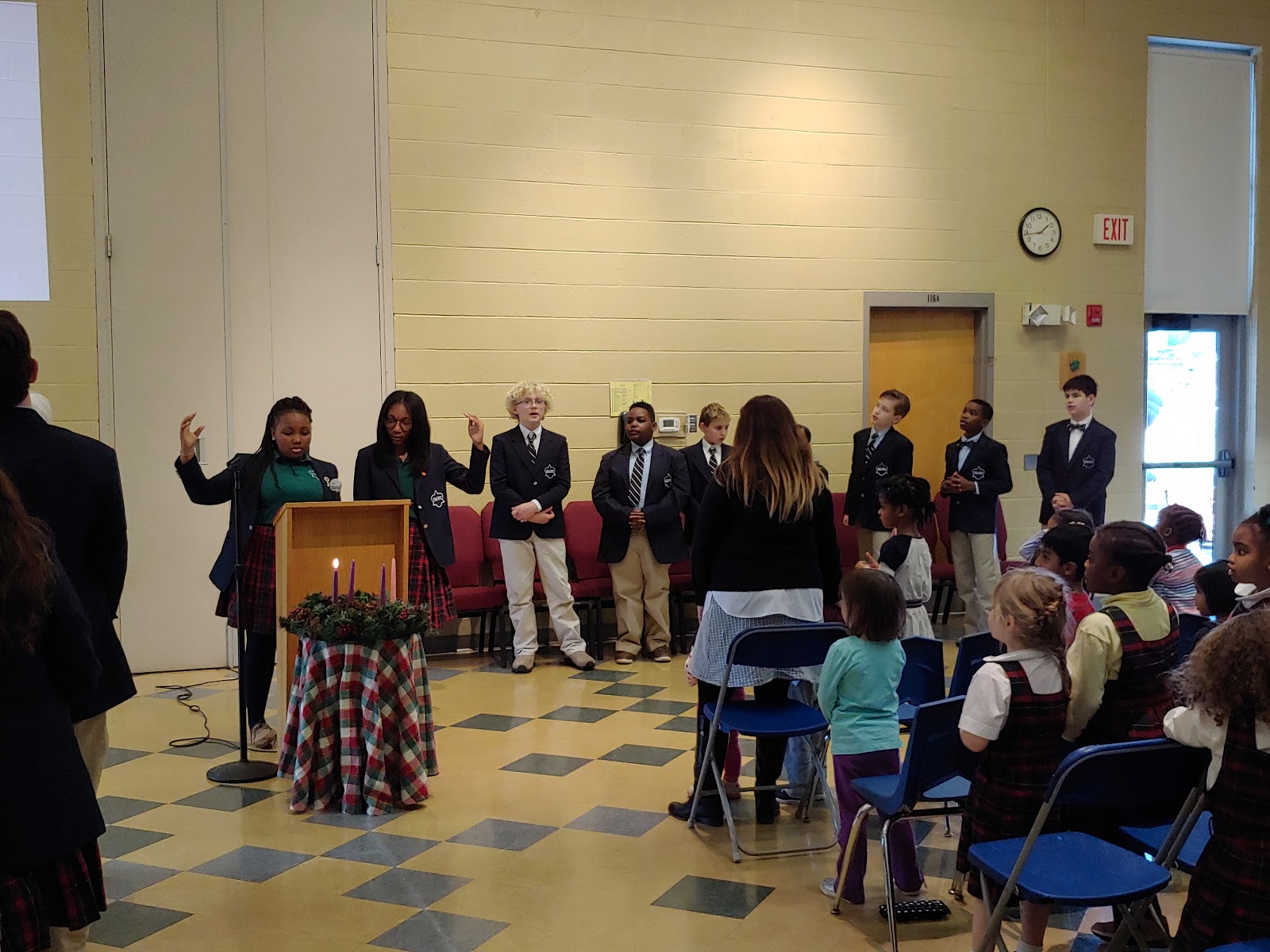
They were also busy with school-wide service projects and leading an Advent prayer service for the entire community...well done!


The entire student body, faculty, and staff are supporting The Providence Center, a Holy Child Mission, this holiday season and the 7th grade wrote this jingle to raise awareness here at HCA about the project...click on the link below to see them in action!


Remember, skills are built, not born. Keep working hard!

Merry Christmas to all!

Friday, November 16, 2018

Middle School Science - November 2018

     Grade 6 finished their unit on Natural Resources investigating the 3 R's - Reduce, Reuse, and Recycle. They collected and reused common materials (except glass and cans) that are collected by local communities as part of municipal recycling programs and used those items to create 3R City! The class did a great job of collaborating and communicating with each other while they came up with different ideas and their final creation! They also made a repurposed spokesperson to accompany 3R City in the Middle School elevator area for the rest of the school to enjoy.


Grade 5 took a deep dive into chlorophyll and photosynthesis. The class gathered various leaves from our campus and extracted the chlorophyll by pressing the leaves onto coffee filters. Then they performed some liquid chromatography over two days to discover what colors of chlorophyll were in the leaves they collected. Various shades of green, yellow, red, purples, and orange were discovered in green leaves!


The 7th Grade began their study of prokaryotic and eukaryotic cells. They compared plant cells to animal cells and learned about cell organelles, their structure, function, and location. They will use the microscope to compare and contrast plant and animal cells before Thanksgiving break. One of the really fun activities they performed was making cell cake models. Each student was responsible for bringing in something tasty that resembles their assigned organelle (special thanks to Taylor and Ryan for making the cakes...er, cells!). We had a great time decorating the cake while reinforcing our knowledge about each organelle in the cells. But I think the students will all agree that the best part was eating their cell creations at the end of class!


Grade 8 investigated changing states of matter using several computer simulations in class. They learned that water melts and freezes at the same temperature...how could that be? They know! They used a phase change graph to model the different states of matter and how energy changes with each phase. Our eldest class also investigated the proportional relationships of two gas laws: Boyle's Law and Charles' Law. With calculators at the ready, they developed an understanding of how temperature, pressure, and volume have an effect on the behavior of gasses.

The Show Must Go On...even if for just one night!

     The HCA community was, unfortunately, impacted by the evolving presence of the coronavirus when the decision was made to limit the perf...